






















Advanced Certification Program Cloud Computing & Devops Engineering
Carrer Support
Duration
Delivery Mode
Language
English
Level
Beginner to
Intermediate
200+ Placed
Live Training
1:1 Mentorship
EMI Available
Everything You Get in This Course

Industry-Focused Projects
- 5+ real-world projects
- Build job-ready portfolios
- Hands-on problem solving
- Practical exposure to industry scenarios

Career Support
- Resume & LinkedIn profile building
- Job placement assistance
- Mock interviews & interview prep
- Career guidance from experts
- Opportunities to showcase your skills

Live Instructor-Led Training
- Live interactive sessions
- Weekday & Weekend batches
- Recorded sessions for revision
- 24×7 mentor support
- Doubt-solving & guided learning

Hands-On Learning
- Practical hands-on projects
- Real-world case studies
- Data-driven problem solving
- Industry-relevant assignments
- Learn by doing approach

Certification
- Industry-recognized certification
- Proof of skill & course completion
- Shareable digital certificate
- Adds value to your resume
- Valid for career growth

Networking
- Peer-to-peer learning environment
- Collaborate on projects
- Community discussions & support
- Networking with like-minded learners
- Knowledge sharing sessions

Capstone Project & Mentorship
- Final capstone project
- Apply all learned concepts
- Guided by industry mentors
- Real business problem solving
- Career-focused project experience
Master these Tools


Course Curriculum
1.SDLC
-
SDLC
- SDLC
- The Waterfall Model
- An Overview of the Agile Methodology
- Transforming SDLC using Cloud and DevOps
2.Python Programming
- Introduction to Python
- Loops
- Conditional Statements
- Arrays, Sets, OOPs,etc.
- Oops
- Classes
- Sets
- List
- Flask
- Flask
- Routing
- Introduction to Database and Flask
- Database
- MongoDB and PyMongo
3.Git and GitHub
- Introduction to Gitand Github
- Version Control using Git
- Using GitHub for Collaborative Software Development
- Advance Git
- Git Merge
- Branching
- Git Reset
4.Agile
- Agile
- Agile Principles: Understand Effective Project Management Scrum and Kanban Apply Frameworks in Practice
- Adaptive Leadership: Develop Skills in Agile Environments Iterative
- Adaptive Leadership: Develop Skills in Agile Environments Iterative Development: Implement Continuous Improvement Techniques
- Team Collaboration: Foster Effective Communication
Problem-solving: Enhance decision-making abilities in Agile Projects.
5.Testing, Linux and Servers
- 1.Testing using Pytest
- Pytest Fundamentals
- Test Case Creation
- Test Automation
- Result Analysis
- Testing Efficiency Improvement
- Introduction to Linux and Commands
- Linux OS
- Ubuntu
- File System and Permissions
- Ubuntu Commands
- File System
- Permissions
- Bash Programming
- Bash Scripts
- Loops
- Functions
- Variables
- Understanding Networking
- OSI Model
- TCP/IP
- Routing
- Apache2, and Nginx
- Web Servers
- Apache 2
- Nginx
- Project
- Understand the CI-CD Pipeline Workflow using traditional methodology (bash, python, git, etc.).
6.Cloud Essentials
- Introduction to CloudEssentials
- SAAS
- PAAS
- IAAS
7.AWS Cloud Deployment
- AWS Major Services
- Introduction to AWS IAM
- EC2
- Elastic IPs
- VPC
- SSL Implementation
- AWS S3 and RDS
- RDS
- S3
- Backups
- Glacier
- AWS VPC
- Understanding the VPC design
- Working with public-private subnet, NAT, IGW VPC
- Peering
- Elastic Load Balancer, AMIs and ASG
- Configuring and Managing AWS Elastic Load Balancer
- Amazon Machine Images
- Auto Scaling Groups (ASG)
- Integrating ELB, AMIs, and ASG
- Project: Deploying MERN / Python based Application in AWS
- AWS Account Setup
- EC2 Instances
- Networking Setup
- Load Balancing
- Auto Scaling
- Security and Identity
- Database Configuration
- Storage and CDN
- Deployment Automation
- Monitoring and Logging
- AWS CloudFront and SSL
- Creating and Configuring CloudFront Distributions
- Content Delivery and Caching Strategies
- Security and Access Control in CloudFront
- Monitoring and Optimizing CloudFront
8.Lightsail
-
Lightsail
- Instance Management
- Networking Configuration
- Application Deployment
9.Serverless Architecture & Cloud Automation
-
Automating using Boto3
- Boto3 Introduction
- AWS Service Interactions
- Scripting Automation
-
AWS Lambda and Cli
- AWS CLI
- Lambda
- EBS
- Develop practical skills in designing and implementing serverless solutions and automating using Generative AI
-
AWS SNS and SQS
- AWS SES
- SNS
- SQS
10.AWS Elastic Beanstalk
-
AWS Elastic Beanstalk
- Deploying python based application on Elast
11.CI/CD Pipeline
-
Github Actions
- GitHub Actions
- Software Development Flow
-
Introduction to CI/CD Pipeline
- CI/CD Pipeline
- Fundamentals of Pipeline
-
Jenkins
- Jenkins
- Groovy Code
- Optimising Jenkins Pipeline
- Configuring Agents
- Caching
- Pipeline optimization using Gen AI
12.AWS CodePipeline
-
AWS CodePipeline
- AWS Codebuild
- Codecommit
- End-to-end Pipeline
13.Containerization and Container Orchestration
-
Introduction to Containers and Docker
- Containerization
- Docker
-
Docker Hub and Docker Compose with GenAI
- Docker Hub
- Docker Compose
- Optimizing and automating Dockerfile using Gen AI
-
ECR, ECS and Fargate
- AWS ECR
- ECS
- AWS Fargate
-
Docker Swarm and Introduction to Kubernetes
- Docker Swarm
- Container Orchestration, K8s
-
Kubernetes Project
- Kubernetes Horizontal Pod Autoscaler (HPA), Vertical Pod Autoscaler (VPA)
- Kubernetes Services, Ingress Controllers (NGINX, Traefik)
- GitOps, ArgoCD
- Helm
- EKS
- Deploying and Scaling Web Application
14.Automation
-
Terraform with GenAI
- IAC, and Terraform
- Terraform states and environment management
- Terraform infrastructure using GenAI
-
Ansible
- Configuration Management using Ansible
-
GitOps – ArgoCD
- GitOps
- ArgoCD
-
Project
- Terraform
- Ansible
15.Cloudformation
-
Cloudformation
- AWS CloudFormation
- CloudFormation Stacks
- CloudFormation Templates
16.Monitoring
-
Graffana and Prometheus
- Graffana and Prometheus
-
AWS Cloudwatch
- AWS Cloudwatch
-
ELK Stack
- Elasticsearch
- Logstash
- Kibana
17.Architecture
-
AWS Architecture
- Understand key services like EC2, S3, RDS, VPC, and IAM and how they fit into AWS architecture
- Explore multi-AZ, load balancers, and auto-scaling concepts for resilient architecture
- Design a web-tier, app-tier, and database-tier using AWS services in a secure VPC setup
-
API & Deployment Strategies
- Create RESTful APIs using Amazon API Gateway and integrate with AWS Lambda for serverless execution
- Deployment Models: Blue/Green, Canary, Rolling
- Redis & Kafka
-
Optimizations & Recovery Designing Architecture
- Use tools like AWS Cost Explorer, Trusted Advisor, and choose the right instance types and pricing models
- Leverage caching (CloudFront, ElastiCache) and compute scaling (ASG, Lambda) for better performance
- Implement snapshots, AMIS, cross-region replication, and recovery strategies using services like AWS Backup
- Use microservices, auto-scaling, and stateless design patterns for scalable architecture
- Security Best Practices: Design secure applications with IAM roles, security groups, KMS, and VPC endpoints
-
Migration
- Migration Strategies
- AWS Migration Tools: Explore tools like AWS Migration Hub, Application Discovery Service, and Server Migration Service (SMS)
- Planning & Execution Steps: Cover pre-migration assessment, cutover planning, testing, and validation
18.Azure
-
Azure Administrator and Networking
- Overview of Azure core services, subscription structure, and the Azure Portal; manage users, roles, and access using Azure Active Directory (AAD)
- Introduction to Azure virtual networking: create VNets, subnets, NSGs, and understand basic network routing and peering
-
Azure Databases & Storage
- Explore Azure Storage types: Blob, File, Queue, and Table storage, with lifecycle and access management
- Overview of Azure SQL Database, Cosmos DB, and basic provisioning, scaling, and security configurations
-
Azure DevOps
- Understand Azure DevOps services: Repos, Pipelines, Boards, and Artifacts for CI/CD lifecycle management
- Create a basic pipeline to build and deploy code using Azure Pipelines with GitHub or Azure Repos integration
-
Azure DevOps – 2
- Implement release pipelines, environment approvals, and deployment strategies (rolling, blue/green)
- Integrate Infrastructure as Code (IaC) using ARM templates or Terraform with Azure Pipelines
-
Azure Monitoring and Governance
- Use Azure Monitor, and Log Analytics to track performance and troubleshoot resources
- Apply governance using Azure Policy and Cost Management to enforce compliance and budget controls
19.GCP
-
Introduction to GCP and Networking
- Overview of GCP services, projects, billing, and resource hierarchy (organization, folders, projects)
- Set up Virtual Private Cloud (VPC), subnets, firewalls, and understand GCP’s global network architecture
-
GCP Storage and Databases and IAM
- Explore Cloud Storage, Cloud SQL for storing structured and unstructured data
- Manage user access and security using Identity and Access Management (IAM) roles and policies
-
Pipeline Architecture in GCP
- Design and build CI/CD pipelines using Cloud Build, Cloud Source Repositories, and Artifact Registry
- Automate deployments with Cloud Deploy or integrate GCP with GitHub Actions or Jenkins
-
GCP Monitoring and Logging
- Monitor infrastructure and applications using Cloud Monitoring, dashboards, and uptime checks
- Use Cloud Logging and Error Reporting to collect, filter, and analyze logs across GCP services
-
Serverless in GCP
- Build and deploy applications using serverless services like Cloud Functions, Cloud Run, and App Engine
- Understand event-driven architecture and integrate with Pub/Sub, Cloud Storage
Who Can Enroll in Our Courses

Future-Ready Students
Get ahead in campus placements by mastering in-demand AI and tech skills.
Aspiring Tech Professionals
No prior experience required — learn step-by-step from core fundamentals.
Working Professionals
Flexible schedules so you can upskill and grow while working full-time.

Fresh
Graduates
Become job-ready with hands-on projects and an industry-focused portfolio.
Enquire Now
Fees Structure
Total Amount:- 84,999/-
EMI Options
| No Cost EMI | Standerd EMI |
|---|---|
| 14919/ Month (For 6 Month) | 4243/ month (For 24 Month) |
Fees Structure
Meet Your Expert Mentors

Rishu Raj Verma

Ashutosh Sharma

Bhawana aggarwal

Pawan Singh

Sandeep Sharma

Dilip Andrew

Joan Sebastian Cruz García

Mrinalini Agarwal Singh

Ashutosh Sharma

Rishu Raj Verma

Bhawana aggarwal
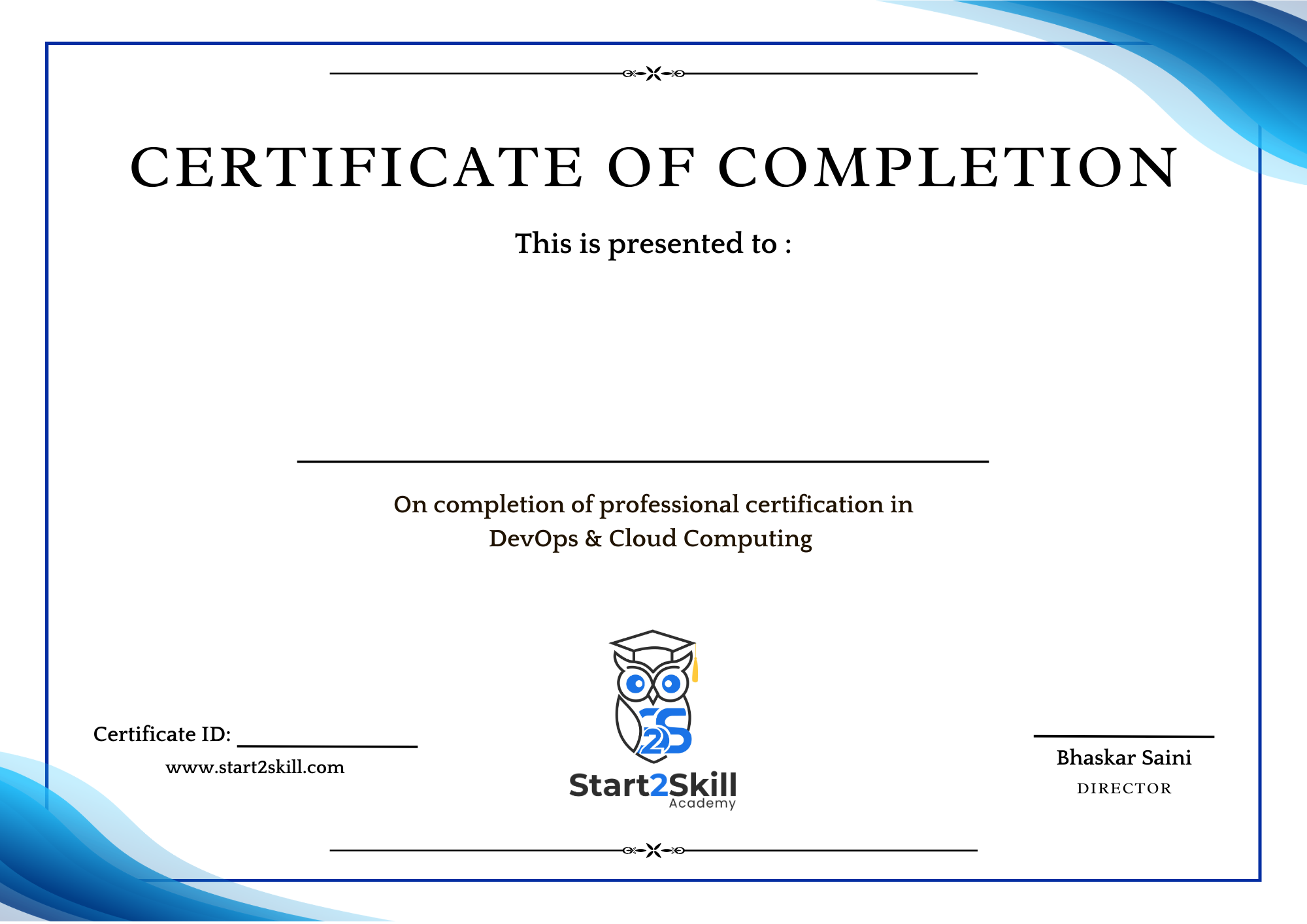
Get certified by Start2Skill
Earn industry-backed
Recognition and Career Opportunities


Industry-Endorsed Certificate
Get certified upon course completion with a recognized credential, validating your skills in Data Science andBusiness Intelligence.

Strong Peer Network
Become part of a thriving community of learners and
professionals from top companies.

Recognized Across Industries
Our certification is trusted by hiring managers across domains—ideal for career switchers and freshers alike.
Industry-Ready Success Stories


The Path to Your Tech Career

Talk to a Program
Advisor
Book a free 1:1 counselling call

Enroll in the Right
Course
Get a plan matched to your goals & level.

Learn with Live + Hands-on Projects
Attend live classes and build r

Get Career Guidance & Placement Support
Resume, interviews & job referrals.
Frequently Asked Questions
What will I learn in the Start2Skill Cloud Computing and DevOps Certification?
You will master the complete DevOps lifecycle and multi-cloud management. The curriculum covers foundational Linux and Python, followed by deep dives into AWS, Microsoft Azure, and Google Cloud Platform (GCP). You’ll gain hands-on expertise in industry-standard tools like Docker for containerization, Kubernetes for orchestration, Jenkins for CI/CD, and Terraform for Infrastructure as Code (IaC).
Is this course suitable for beginners or non-IT professionals?
Yes. Start2Skill’s Advanced Program is designed with a “zero-to-hero” approach. We begin with the fundamentals of networking and operating systems to ensure students from non-technical backgrounds can transition smoothly. The program progressively moves to advanced engineering concepts, making it ideal for fresh graduates, system admins, and software developers looking to upskill.
How does Start2Skill provide practical experience in Cloud and DevOps?
Unlike theoretical courses, Start2Skill focuses on Project-Based Learning. Students work on 10+ real-time industry projects, including building automated CI/CD pipelines, deploying microservices on Kubernetes, and managing cloud infrastructure using Terraform. This hands-on approach ensures you have a professional portfolio to show employers by the end of the program.
What career roles can I apply for after completing this Advanced Certification?
This certification prepares you for high-demand roles such as Cloud Engineer, DevOps Engineer, Site Reliability Engineer (SRE), Build & Release Engineer, and Cloud Architect. With the rise of “Cloud-First” strategies in global enterprises, our graduates are equipped to work in any organization utilizing automated software delivery.
Does the program offer placement assistance or job support?
Yes, Start2Skill provides dedicated Career Excellence Support. This includes professional resume building, LinkedIn profile optimization, and 1-on-1 mock interviews with industry experts. We also provide access to our hiring partner network to help you secure interviews at top tech companies and startups.
Why should I choose Start2Skill over other Cloud and DevOps courses?
Start2Skill offers a unique Hybrid Learning Model—combining live instructor-led sessions with self-paced practical labs. We differentiate ourselves by providing 24/7 technical support, lifetime access to course updates (essential in the fast-moving cloud space), and mentorship from engineers currently working at Fortune 500 companies.
Which Cloud platforms are covered: AWS, Azure, or GCP?
The program covers all three major providers—AWS, Azure, and GCP. While we focus deeply on AWS as the market leader, we provide specialized modules on Azure DevOps and Google Cloud infrastructure. This multi-cloud approach ensures our students are versatile and ready for “Hybrid-Cloud” environments favored by modern enterprises.